That one rainy race that changed how I look at the top marathon running watches
The sky was a bruised purple over the Verrazzano-Narrows Bridge during the 2025 New York City Marathon, and my hands were so cold I could barely feel my fingers, let alone the start button on my wrist. I remember looking around at the thousands of runners nervously checking their screens, all of us hoping our satellites would lock before the cannon fired. That’s the reality of the 26.2-mile journey. It isn’t just about the training; it’s about the trust you place in the gear on your wrist. When you’re hunting for the top marathon running watches, you aren’t looking for a fashion statement. You need a piece of equipment that handles the “urban canyons” of Manhattan and the brutal battery drain of a four-hour effort.
Over the last decade, I’ve gone from running with a basic stopwatch to testing every high-tech wearable on the market. By 2026, the technology has reached a point where we’re no longer just measuring distance; we’re measuring “Running Tolerance” and form efficiency in real-time. I’ve spent the last six months putting the latest flagship models through their paces—literally—to help you figure out which of the top marathon running watches belongs on your arm for your next training cycle.
The Garmin Dominance: Forerunner 970 and 570
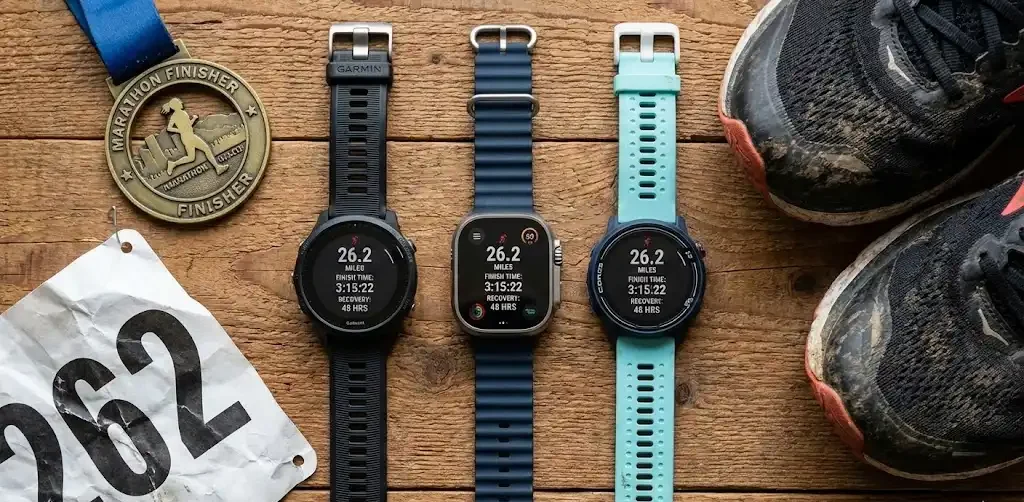
It’s nearly impossible to have a conversation about the top marathon running watches without starting with Garmin. I’ve been wearing the Forerunner 970 since its release in mid-2025, and it has fundamentally changed how I approach my taper. According to the detailed review from The Guardian, the 970 has set a new benchmark for what a performance wearable should be.
One feature that stands out is the “Running Tolerance” metric. I used to be the guy who would feel a slight twinge in my calf and ignore it, only to end up in physical therapy two weeks later. The 970 actually analyzes your cumulative impact load and tells you exactly how much “tolerance” your legs have left for the week. During my peak 70-mile week for the Berlin Marathon, my watch actually suggested I cut my Friday recovery run by three miles because my mechanical load was spiking. I listened, and for the first time in three years, I hit the start line without a “niggle.”
If the 970 feels like too much watch—or too much of an investment—the Forerunner 570 is the smarter play for most road runners. It strips away the maps and the titanium bezel but keeps the essential “Running Economy” sensors. As Garmin’s own newsroom notes, both models now feature the brightest AMOLED screens they’ve ever produced. I’ve found that even in the glaring midday sun of a July long run, the data pops. For those seeking the top marathon running watches that balance price and pro-level metrics, the 570 is the unsung hero of the 2026 lineup.
The Coros Pace 4: The Weightless Wonder
I have a friend who is a true “weight weenie.” He trims the tags off his running shirts and weighs his racing flats on a kitchen scale. For him, and for many elite-minded runners, the Coros Pace 4 is the clear winner among the top marathon running watches. At just 32 grams with the nylon band, you genuinely forget you’re wearing it.
I took the Pace 4 out for a humid 22-miler last month, and the technical specs from Coros don’t lie—the battery life is staggering. Even with the “Always-On” AMOLED display active, it can handle over 30 hours of full dual-frequency GPS tracking. In the world of top marathon running watches, Coros has always been the king of efficiency. They don’t bloat their watches with voice assistants you’ll never use or speakers that sound like tin cans. They focus on the data.
The “Effort Pace” metric on the Coros is something I wish every brand would copy. It uses an internal algorithm to tell you how hard you’re working based on the grade of the hill, not just your speed. If you’re training on hilly terrain, the Pace 4 is arguably the most helpful of the top marathon running watches because it prevents you from overcooking it on the inclines.
The Apple Watch Ultra 3: Beyond the Lifestyle
For a long time, serious marathoners looked at Apple users with a bit of a smirk. “Does that thing even have a physical lap button?” we’d ask. With the Ultra 3, that skepticism has mostly evaporated. I wore the Ultra 3 for the Chicago Marathon last year, and its performance in the “shadows” of the Sears Tower was impressive. As DC Rainmaker points out in his in-depth review, the 5G and satellite connectivity make it a safety powerhouse, but the “Action Button” is what makes it a runner’s watch.
The reality of top marathon running watches is that they need to work when you are exhausted. At mile 23, your brain is “mush,” and your fingers are sweaty. Trying to swipe a touchscreen to mark a lap is a recipe for a meltdown. The Ultra 3’s physical button allows for “Precision Start” and manual laps, which is non-negotiable for me. Plus, the 42-hour battery life means you can actually do a marathon, go to the after-party, and still have enough juice to navigate your way back to the hotel using Apple’s updated offline maps.
GNSS and the Science of Accuracy
Let’s get into the weeds for a second because as an industry insider, I see a lot of marketing fluff about “GPS accuracy.” In 2026, the gold standard for top marathon running watches is L1 + L5 dual-frequency GNSS. Most people don’t realize that standard GPS signals can bounce off buildings or even heavy tree cover, creating “multipath interference.” This is why your watch might tell you that you ran a 5:30 mile when you were clearly struggling at an 8:00 pace.
The L5 frequency is a higher-bandwidth signal that is much harder to “confuse.” According to research on smartwatch RTK positioning, using multi-band systems can bring your positioning accuracy down to the meter level even in challenging environments. When you’re looking at top marathon running watches, don’t just look for “GPS”—look for “All-Systems Dual-Frequency.”
A pro tip I always give my athletes: do the “GPS soak.” Even the top marathon running watches need a moment to breathe. When you step outside, don’t just wait for the “Ready” signal. Give it an extra two minutes to fully download the satellite almanac. I’ve seen 2% differences in total distance just based on whether someone did a proper soak or not. In a marathon, 2% is the difference between a PR and a “what happened?” moment.
The European Contenders: Suunto and Polar
While Garmin and Apple fight for the headlines, Suunto and Polar are quietly producing some of the top marathon running watches for those who want something a bit different. I’ve been testing the Suunto Race 2 lately, and the build quality is phenomenal. They use a “Digital Crown” that feels much more tactile than Apple’s, making it easy to scroll through data pages while wearing gloves.
As noted by The Run Testers, the Suunto Race series is often better value than the high-end Garmins, offering similar AMOLED screens and mapping for a few hundred dollars less. Meanwhile, Polar continues to lead in heart rate science. Their Vantage V3 is frequently cited as having the most accurate wrist-based heart rate sensors, though I’ll still argue that a chest strap is mandatory for race day (more on that in a minute). If your training involves a lot of vertical gain, Suunto’s altimeter tech is arguably the most stable among the top marathon running watches I’ve tested this year.
The “Wrist Trap”: Why You Still Need a Strap
Here is some honest, insider truth: even the top marathon running watches in 2026 struggle with “cadence lock.” This happens when the optical sensor on the back of the watch misinterprets the rhythmic “bounce” of your arm as your heartbeat. I was doing a tempo run last Tuesday, and my watch suddenly told me my heart rate was 185 bpm. I felt fine—if my heart were actually at 185, I’d be seeing spots. The watch was simply counting my 185 steps-per-minute cadence as my pulse.
If you are using any of the top marathon running watches to guide your race strategy, you must pair them with a chest strap like the Garmin HRM-Pro or a Polar H10. The electrical signals measured by a strap are infinitely more reliable than the light-based sensors on your wrist. For easy runs, the wrist is fine. For the big dance, get a strap. It’s the only way to ensure the data you’re seeing at mile 20 is actually representative of your effort.
Form, Economy, and the Psychology of the Taper
The newest frontier for top marathon running watches is “Running Economy.” We are now seeing watches that can estimate your “Step Speed Loss”—essentially how much energy you lose every time your foot hits the pavement. I’ve been using this data to work on my ground contact time. By shortening my stride slightly, I was able to improve my economy by about 4%, which theoretically saves a massive amount of glycogen over the course of 26 miles.
But there’s a psychological side to these top marathon running watches that we don’t talk about enough. The “Training Readiness” scores can be a double-edged sword. I’ve seen runners wake up on race morning, see a “Poor Recovery” score on their watch, and mentally check out of the race before they even reach the start line. You have to remember that these are tools, not oracles. If you feel great but your watch says your HRV is low, trust your body. The top marathon running watches are there to provide a baseline, but they don’t know about the adrenaline of a race day or the “magic” of the crowds in Boston or Chicago.
Comparison of the Top Contenders for 2026
| Feature | Garmin Forerunner 970 | Coros Pace 4 | Apple Watch Ultra 3 | Suunto Race 2 |
| Weight | 52g | 32g | 61g | 60g |
| Battery (GPS) | 32 Hours | 41 Hours | 20 Hours | 40 Hours |
| Maps | Full Offline | Breadcrumb Only | Full Offline | Full Offline |
| Key Metric | Running Tolerance | Effort Pace | 5G / Safety | Vertical Recovery |
| Price (Est) | $599 | $249 | $799 | $449 |
FAQ: Your Questions on top marathon running watches
Q: Is an AMOLED screen actually better for racing?
A: In the past, we preferred MIP (Memory-in-Pixel) screens because they were easier to read in direct sun. However, the top marathon running watches of 2026 have such high-nit AMOLED displays that they are actually easier to read in all conditions. Plus, the high contrast makes it much easier to glance at your pace when you’re hitting the wall and your vision is getting blurry.
Q: How long will the battery last on a 5-hour marathon?
A: Every watch on this list of top marathon running watches will easily last a 5-hour marathon. In fact, most can handle back-to-back marathons on a single charge. The only thing that really kills the battery is playing music directly from the watch, so if you’re a back-of-the-pack runner who loves podcasts, keep an eye on your percentages.
Q: Do I need a sapphire lens?
A: If you only run on the road, probably not. But if you’re clumsy like me and occasionally trip over a curb or drop your watch on the pavement while changing, sapphire glass is worth the extra $50–$100. Most top marathon running watches now offer a “Sapphire” or “Pro” version for exactly this reason.
Q: Can these watches help me if I get lost?
A: Yes, models like the Garmin 970 and Apple Ultra 3 have full mapping. If you take a wrong turn in a big race (it happens!), you can use the “Back to Start” feature to find your way back to the course. This is also a lifesaver for training runs in unfamiliar cities.
Q: Is “Running Economy” a useful stat?
A: It’s useful if you have a coach or the patience to analyze it over months. For a casual runner, it might be TMI (too much information). But for those looking for every possible advantage, it’s a standard feature in the top marathon running watches today.
Q: Which watch is best for small wrists?
A: The Coros Pace 4 and the Garmin Forerunner 570 (S version) are the best bets. The Apple Ultra 3 is a “tank” on the wrist and can feel quite bulky if you have smaller forearms.
Q: What is the “GPS Soak” exactly?
A: It’s simply letting your watch sit with a clear view of the sky for 2–3 minutes after it says it has a signal. This allows it to lock onto more satellites and download the latest data to ensure your tracking is as smooth as possible. Even the top marathon running watches benefit from this.
Q: Can I use these for swimming too?
A: Almost all top marathon running watches are now rated for 5ATM or 10ATM, meaning they are perfectly fine for pool or open-water swimming. If you’re a triathlete, these are all dual-purpose tools.
Q: Should I buy now or wait for the 2027 models?
A: In 2026, the tech has stabilized significantly. We aren’t seeing the massive “leap” in GPS accuracy that we saw a few years ago because we’re already at the physical limits of the satellites. If you need a watch for this season, any of these top marathon running watches will serve you well for the next 3–4 years.
Closing Thoughts: The Heart of the Run
At the end of the day, no piece of technology can do the work for you. I’ve had my best races wearing a $20 Timex and my worst races wearing the most expensive gear on the planet. The value of the top marathon running watches isn’t in the fancy screen; it’s in the consistency they bring to your training. They help you stay injury-free, they keep your pacing honest, and they give you a sense of confidence when you’re standing in that starting corral.
Pick the tool that fits your budget and your wrist size. Don’t get bogged down in every single data point—use the watch to support your intuition, not replace it. Running 26.2 miles is a deeply human endeavor, and while the top marathon running watches are incredible, the real magic happens in your lungs and your legs.
Additional Helpful Information
- Read a comparison of Apple Watch and Garmin – Apple Watch Ultra vs Garmin: Ultimate Smartwatch Showdown
- Information about the best smartwatches for athletes – Top Performance Sports Watches